
The Real Cost of Buying Property in 16 European Countries — What Nobody Tells You
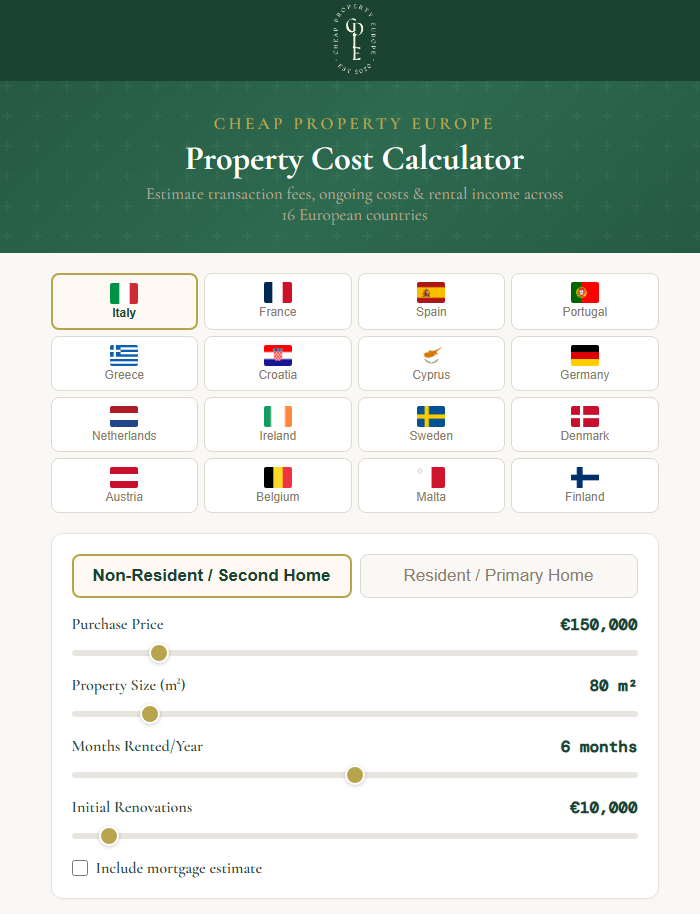
We built a free calculator so you can see exactly what you'll pay. Here's what the data revealed.
You've found a beautiful stone farmhouse in Italy for €150,000. You've done the maths on your savings. You're ready to make an offer.
But the house doesn't cost €150,000. It costs €171,000. Or €162,600. Or €152,850. It depends entirely on which country you're buying in — and most buyers don't discover the real number until they're already knee-deep in legal paperwork.
We've spent years helping subscribers find affordable properties across Europe, and the question we hear more than any other is: "I know the house price, but what does it actually cost to buy?" The answer varies so dramatically between countries that we built a calculator to show you. And when we ran the numbers across all 16 countries, some of the results genuinely surprised us.
Here are five things we didn't expect.
1. The gap between cheapest and most expensive is enormous
On a €150,000 property, here's what you'd pay in transaction fees as a non-resident buyer:
Cheapest three:
- Denmark: €2,850 (1.9%)
- Ireland: €3,600 (2.4%)
- Sweden: €4,725 (3.1%)
Most expensive three:
- Netherlands: €21,150 (14.1%)
- Belgium: €21,750 (14.5%)
- Cyprus: €37,800 (25.2%)
That's a €34,950 difference between Denmark and Cyprus — on the same budget property. Most articles about buying in Europe compare house prices. Almost nobody compares what it costs to actually complete the purchase. The Nordics are staggeringly cheap to transact in. Denmark's registration fee is just 0.6% plus a small fixed charge. There's no buyer-paid agent fee, no separate VAT on services, and no notary requirement. Compare that to Belgium, where the registration tax alone is 12.5% in Brussels and Wallonia.
This doesn't mean Denmark is a better investment — the ongoing costs and rental returns tell a different story — but if your budget is tight, knowing that transaction costs can eat anywhere from 2% to 25% of your capital before you've even turned the key is essential.
2. Italy's registration tax isn't as bad as everyone thinks
If you've researched buying in Italy, you've probably read that the registration tax is 9% for non-residents. That's technically true — but it's misleading.
Italy calculates this tax on the cadastral value of the property, not the purchase price. The cadastral value is an official government valuation that typically sits at 50–70% of the actual market price, especially for older properties in smaller towns — exactly the kind of properties our newsletter features.
What this means in practice: on a €150,000 purchase, you're not paying €13,500 (9% of €150k). You're paying closer to €8,100–€9,450 (9% of the cadastral value). That's a difference of €4,000–€5,400 that most buyers over-budget for.
Our calculator uses an effective rate of 4.5% for non-residents to reflect this reality. It's a rough estimate — your actual cadastral value depends on the specific property — but it's far closer to what you'll actually pay than the headline 9% figure that appears in most guides.
3. Seven countries charge you VAT on top of your lawyer and notary fees
You'd expect to pay a lawyer. You'd expect to pay a notary. What catches many buyers off guard is the VAT charged on top of those professional fees — and it varies wildly by country.
Italy charges 22% VAT on your notary, lawyer, and agent fees. On a €150,000 property, that's an extra €2,310 in tax purely on the fees you're already paying. Greece adds 24% (€2,160 extra). Malta adds 18% (€1,890). Germany, Austria, Croatia, and Spain all add their own VAT layers.
Meanwhile, France, Portugal, Ireland, and the Nordics either include VAT in their quoted professional fees or don't apply it separately. The total impact isn't dramatic — 0.2% to 1.5% of the purchase price — but on a tight budget, €2,000 in unexpected taxes can be the difference between affording the renovation or not.
Our calculator breaks this out as a separate line item so you can see exactly what you're paying in fees versus tax on those fees.
4. Whether YOU pay the real estate agent depends entirely on the country
This is one of the most impactful cost differences that nobody talks about, and it's more nuanced than you might expect.
In nine countries, the seller pays the full agent commission and the buyer pays nothing: France, Spain, Portugal, Ireland, Sweden, Denmark, Finland, Belgium, and Cyprus.
In four countries, the commission is split between buyer and seller — meaning you're paying your share on top of everything else. In Italy, both buyer and seller each pay the agent (typically 2.5–4% each plus VAT — it's written into Italian civil law). Germany splits the fee equally since a 2020 law change. Greece and Croatia also traditionally split the commission, though practices vary by agency.
In three countries — Austria, Malta, and the Netherlands — the buyer typically bears the agent commission directly.
On a €150,000 property, the buyer's share of the agent fee ranges from €3,000 to €5,400 in countries where you're paying. In seller-pays countries, it's zero. That single line item can account for a quarter of the gap in total costs between otherwise similar countries.
Here's a concrete example: a €150,000 house in France costs roughly €12,600 in total transaction fees. The same-priced house in Italy costs roughly €21,000. A significant chunk of that €8,400 gap comes from Italy's buyer-paid agent share plus the 22% VAT charged on top of it.
It doesn't mean you should avoid split-commission countries — some of the best value properties in Europe are in Italy, Greece, and Croatia — but you absolutely need to budget for it.
5. Belgium is the only country where renting doesn't cover your costs
We ran a simple scenario across all 16 countries: buy a €150,000 property, rent it out for six months of the year, and see what's left after income tax and annual property costs.
Every country produces a positive net return — except Belgium. At −€412 per year, Belgium is the only country where a six-month rental doesn't cover the annual carrying costs. The culprit is Belgium's précompte immobilier (annual property tax), which at roughly €2,250 per year is the highest of any country in our calculator.
At the other end, Malta produces €3,506 per year net — thanks to having zero annual property tax and a low 15% flat rate on rental income. Croatia (€2,980), Cyprus (€2,900), and Ireland (€2,400) also perform strongly.
The five-year picture is even more revealing. When you add transaction costs to five years of ongoing costs and subtract five years of rental income, Ireland actually comes out €6,900 ahead — the property essentially pays for its own purchase costs. Belgium, by contrast, costs €35,062 over the same period.
A note on Belgium's regional quirk
Belgium is the only country in our calculator where your costs change dramatically depending on which part of the country you buy in. The registration tax for second homes and holiday properties is 12% in Flanders and 12.5% in Brussels and Wallonia. But if you're buying a primary residence, the rates drop to just 2% in Flanders and 3% in Wallonia — among the lowest in Western Europe.
On a €150,000 property, that's the difference between paying €18,750 in registration tax (second home in Brussels) and €3,000 (primary residence in Flanders). Same country, same price, €15,750 difference.
If you're considering Belgium, the region matters more than almost any other factor in your budget.
Try it yourself
These insights come from the free property cost calculator we built for our subscribers and readers. You can select any of 16 European countries, enter a purchase price, toggle between resident and non-resident rates, and see the full breakdown: transaction costs, annual ongoing costs, rental income estimates, and even mortgage calculations.
All figures are estimates based on government publications, Global Property Guide, and professional surveys (2025–2026). Actual costs vary by property type, location, municipality, and individual circumstances. Always seek professional legal and financial advice before purchasing property.
The calculator shows you the costs. If you want to find the properties, that's what we do every week — curating 20+ handpicked listings under €250,000 from across Europe so you don't have to search thousands of listings yourself.